
C GLOBAL · Çekirdek Global

ESG Financial Intelligence · Issue 14 · Weekly brief

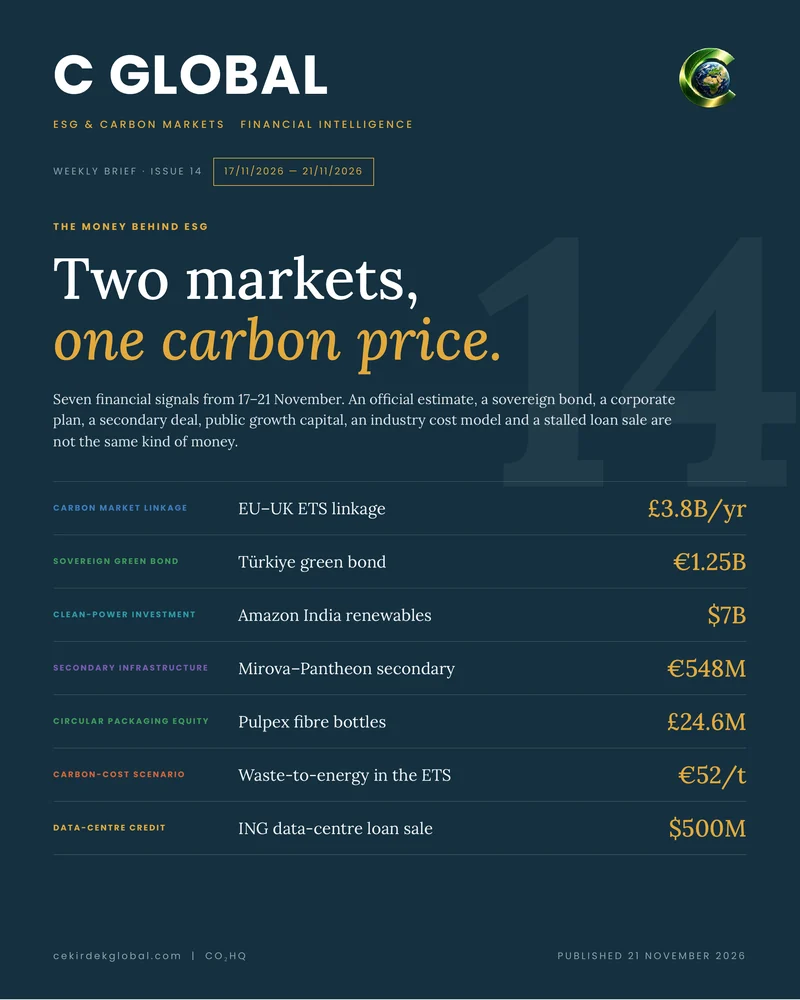
Two markets, one carbon price.

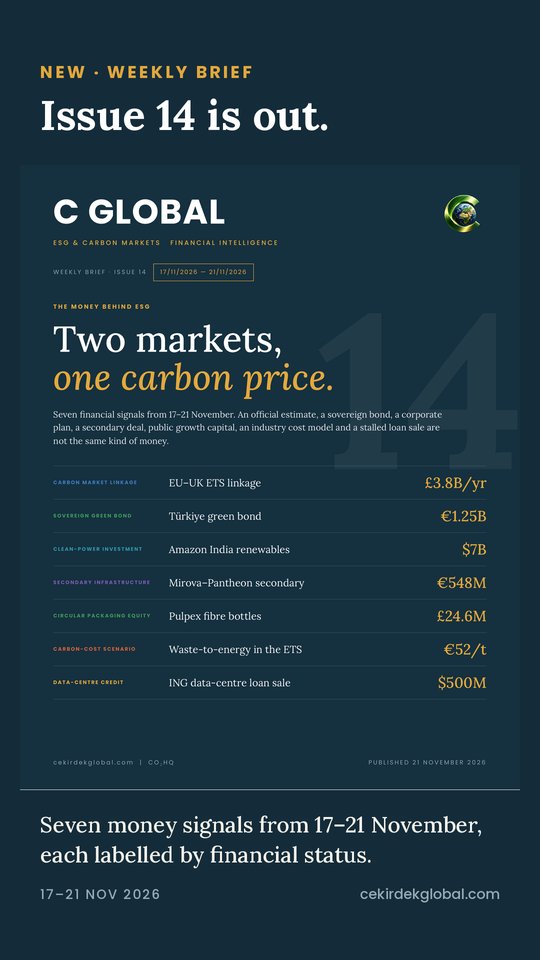
Seven financial signals from 17–21 November. An official estimate, a sovereign bond, a corporate plan, a secondary deal, public growth capital, an industry cost model and a stalled loan sale are not the same kind of money.

Published Covers 17 Nov 2026 – 21 Nov 20267 signals

01£3.8B/yr

Carbon market linkage

EU and UK conclude talks to link their carbon markets, worth up to £3.8 billion a year to the UK

The £3.8 billion is the UK Government’s estimate of the potential annual economic benefit of linking — not a transaction, committed investment or public spending. Separately, about £6.5 billion of UK exports could fall outside the EU CBAM; that is affected trade value, not a quantified saving.

Who gains: UK exporters of carbon-intensive goods, ETS-covered operators in both markets, allowance traders and cross-border CO₂ storage developers. A larger, more liquid market may reduce hedging and compliance costs.

Who pays: No purchase price or payer exists. ETS-covered companies keep paying for allowances; both governments carry registry and implementation costs that were not quantified.

Official estimate
02€1.25B

Sovereign green bond

Türkiye raises €1.25 billion through an eight-year sovereign green bond

The €1.25 billion is sovereign borrowing raised under a green framework — not the value of individual green projects, deployed capital or environmental impact. At the stated coupon, annual interest on the full principal is arithmetically about €73.1 million.

Who gains: The Treasury secures eight-year euro funding through a green channel. Investors gain a sovereign instrument paying 5.850%. The eligible projects to be financed were not specified in the announcement.

Who pays: The Republic of Türkiye pays the coupon — about €73.1M a year on the full principal — and repays €1.25B at maturity.

Directly reported
03$7B

Clean-power investment

Amazon plans an additional US$7 billion of renewable-energy investment in India by 2030

The US$7 billion is a forward investment plan — not deployed capital, a completed transaction or the value of the four new power purchase agreements. Amazon says it is additional to US$4 billion already contracted in India.

Who gains: Amazon gains long-term clean power and price visibility for fast-growing data-centre load. Indian developers, equipment makers and grid suppliers gain project demand.

Who pays: Amazon is the stated investor and prospective offtaker. The financing mix and project-level allocation of the US$7B were not disclosed.

Reported commitment
04€548M

Secondary infrastructure

Pantheon backs a €548 million secondary deal for Mirova’s European renewables platforms

The €548 million is the reported transaction size — not new-build project capex or the amount invested in any single asset. Pricing relative to net asset value, including any discount or premium, was not disclosed.

Who gains: Existing investors in the Mirova funds gain an exit option; the renewables platforms gain expansion capital; Pantheon gains a diversified European energy-transition portfolio.

Who pays: Pantheon provides the third-party capital. The deal also reallocates value among existing fund investors; the price versus NAV is unknown.

Directly reported
05£24.6M

Circular packaging equity

Pulpex secures £24.6 million to scale fibre-bottle manufacturing

The £24.6 million is new financing — not company valuation, revenue or a quantified emissions saving. The Glasgow facility has initial capacity of up to 40 million bottles a year; the one-billion-bottle target is an ambition.

Who gains: Pulpex gains growth capital; licensed manufacturing partners gain a commercial reference plant; Scotland gains industrial scale-up and around 39 jobs.

Who pays: The UK National Wealth Fund (£19.6M), the Scottish National Investment Bank (£4.4M) and existing investors provide the funds.

Directly reported
06€52/t

Carbon-cost scenario

CEWEP models a €52 per tonne rise in EU waste gate fees if incineration enters the EU ETS

The €52 is a modelled average cost pass-through, not a current or guaranteed fee increase. Actual impacts would vary with waste composition, allowance prices, free allocation, national rules and how much cost is passed on.

Who gains: Waste-to-energy operators could recover carbon costs through higher gate fees; allowance sellers would see added demand if the sector joins the ETS.

Who pays: Municipalities and waste companies face the first cost, with likely pass-through to households and commercial customers via treatment charges.

Industry model
07$500M

Data-centre credit

ING’s US$500 million data-centre loan auction stalls on weak demand

The US$500 million is the face amount offered — not sale proceeds, a market value or a realised loss. No clearing price or discount has been reported.

Who gains: Prospective buyers gain negotiating leverage and may buy single loans below ING’s expectations, though no discount has been disclosed.

Who pays: ING carries the execution risk of a failed broad auction. Borrowers may face tighter refinancing if lenders reassess exposure to energy-intensive data centres.

Market signal
Read the labels. The EU–UK £3.8B is an official estimate of annual benefit. Türkiye’s €1.25B is issued debt; Amazon’s $7B is a plan; Mirova’s €548M is a secondary deal and Pulpex’s £24.6M new equity. CEWEP’s €52/t is a scenario; ING’s $500M is loans offered, not sold.

Watch

This issue in under a minute

Why the EU–UK link and CBAM matter for Turkish exporters: read Six months of carbon money and COP31 in the world press.

Exporting steel, aluminium, cement or fertiliser to Europe? Start with verified emissions data.

CBAM & carbon markets