
Key takeaways (as of 14 November 2026)
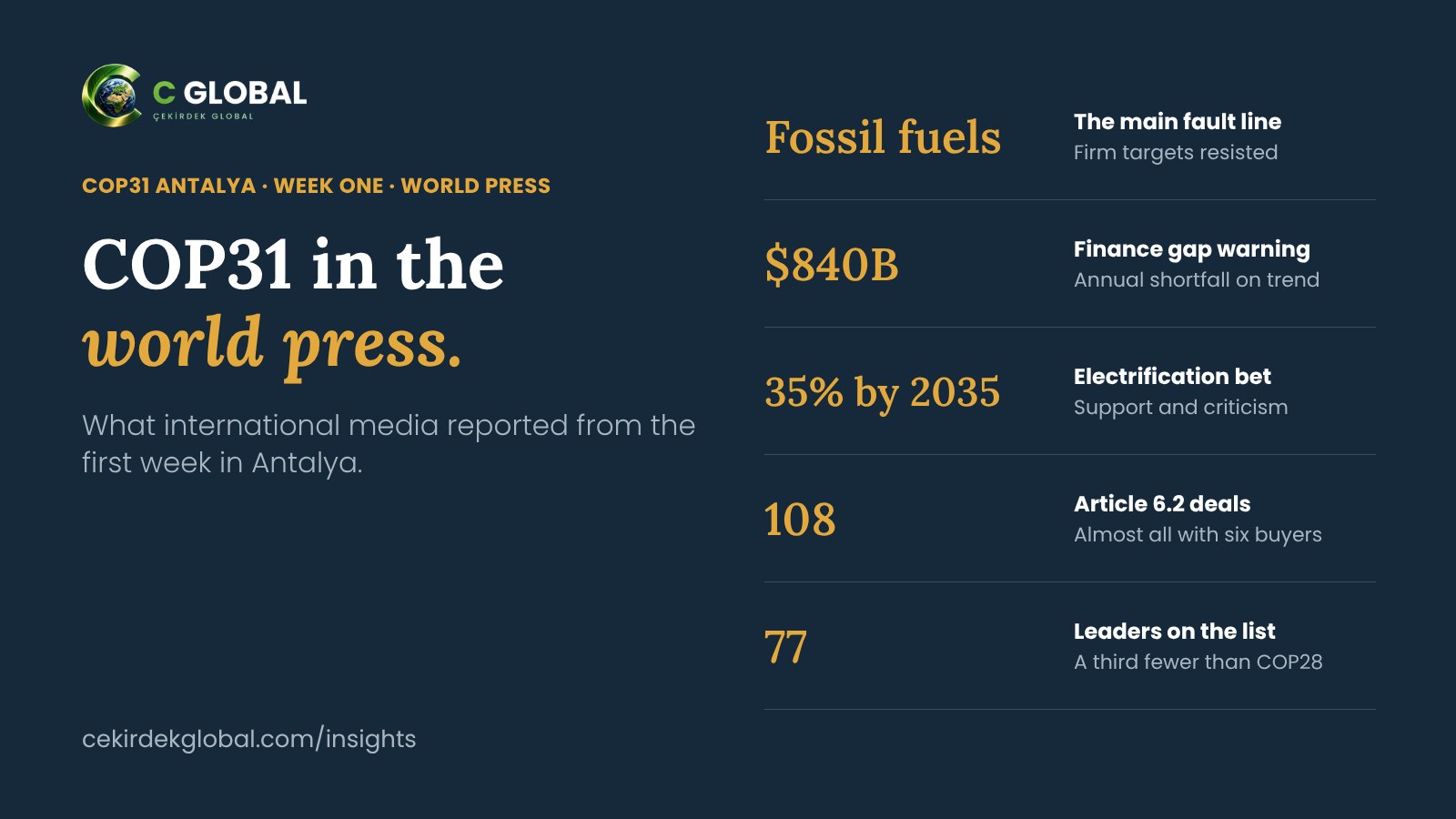
- Fossil fuel language is the main fault line: big producers and consumers resist firm targets, according to Reuters.
- Finance dominates: UN News reports an assessment that annual climate finance could fall US$840 billion short of the larger goal on current trends.
- The "35 by 35" electrification goal (35% of final energy from electricity by 2035) wins support in Europe and from the IEA, but critics say it does not require renewable power.
- Article 6 carbon markets are moving from rules to delivery, but almost all of 108 bilateral deals involve just six buyer countries (Sylvera).
- The US is absent for a second year; only 77 heads of state or government were scheduled to speak, a third fewer than at COP28 (Climate Home News).
Scope of this review
The UN Climate Change Conference COP31 runs from 9 to 20 November 2026 at the Antalya Expo Center. It operates under an unusual split arrangement: Türkiye hosts and holds the presidency, while Australia chairs the formal negotiations. This review covers only what international media and institutions reported during the first week. Coverage and comment from Turkish and Australian media, and statements by officials of the two host countries, are deliberately left out, so the picture is the one the rest of the world is reading.
1. A delayed opening and a call to "get serious"
AFP, in a report carried by Khaleej Times, said the opening ceremony started about ninety minutes late after overnight wrangling over developing countries' demands to add climate finance items to the official agenda. UN Secretary-General António Guterres urged leaders to get serious about the crisis, warning: "We have entered a new age of climate extremes." AFP also reported that a senior EU official had cautioned there would be no political will for extra funding pledges in Antalya, and that observers expect few breakthroughs against a backdrop of an oil price shock and geopolitical conflict.
Balkan Green Energy News noted that the United States did not send representatives for the second year running after leaving the Paris Agreement, and that UNFCCC Executive Secretary Simon Stiell stressed that 90% of large-scale renewable projects are now cheaper than fossil alternatives.
2. Fossil fuels: the main fault line of week one
Reuters reported on 13 November that large fossil fuel producers and consumers are resisting any deal that would set firm new targets or a shift away from oil, gas and coal. Observers told the agency that India and the G77 group oppose firm targets and technology- or fuel-specific language. Guterres called for an "immediate and drastic reduction" in emissions to keep the 1.5°C goal within reach.
According to Reuters, written submissions from countries on a cover decision close on Saturday night, with a draft text expected early in the second week. UN News reported that a first outline of a possible political declaration is circulating, with finance and fossil fuels still unresolved.
3. The leaders' segment: incompatible demands
Reuters described two days of leaders' speeches (11–12 November) as a set of clashing positions that leaves negotiators with a hard task:
- Venezuela: acting president Delcy Rodríguez defended developing the oil industry as a sovereign right.
- Saint Lucia: Prime Minister Philip J. Pierre said major emitters must go beyond their usual promises.
- Small island states (the Bahamas, Tuvalu, Solomon Islands) called for urgent emissions cuts in the face of rising seas.
- European leaders backed the proposal to expand global electrification.
- WWF: climate policy head Fernanda de Carvalho found the speeches underwhelming.
- Greta Thunberg: "The planet is not dying. It is being killed."
Climate Home News had reported before the summit that only 77 heads of state or government were scheduled to address it, a third fewer than at the COP28 peak.
4. Money: the gap is growing
Finance dominated the agenda on Friday 13 November. UN News reported an assessment showing that, on current trends, annual climate finance could fall US$840 billion short of the larger goal, and the launch of a US$10 billion initiative to finance climate projects in emerging markets.
Outlook India summarised the Brazil-led "Baku to Belém Roadmap to 1.3T", which proposes US$1.27–1.41 trillion a year for developing countries by 2035 and estimates that, without new measures, flows would reach only about US$461 billion. Global Finance magazine argued that the problem is also one of capital-market reality: in emerging markets, local-currency hedging can add 800–1,200 basis points a year to financing costs.
5. "35 by 35" electrification: accelerator or loophole?
The presidency's flagship proposal would raise electricity's share of final energy consumption from about 20% today to 35% by 2035. International coverage is split:
- Support: Reuters reported that UK Prime Minister Andy Burnham backed the goal and framed clean power as the route to energy security. Metalnomist reported that the IEA considers the target achievable, and pointed out that it would also act as a global demand signal for copper, aluminium and battery metals.
- Criticism: the Heinrich Böll Foundation argues that the pledge's call for "diverse and sustainable energy sources" does not require electrification to run on renewables and could lock in fossil fuels. Reuters noted that it is unclear whether the extra power would be renewable. Greenpeace welcomed the goal but says it must be paired with a fossil fuel phase-out, and civil society groups are asking for safeguards on mining for transition minerals.
6. Geopolitics: the US is absent, China brings trade to the table
Climate Home News expects climate and trade to be one of the most prominent issues in Antalya, with China, the dominant maker of clean-tech equipment, opposing US and EU tariffs and the EU's Carbon Border Adjustment Mechanism (CBAM). In a Carbon Brief survey of China experts, Kate Logan of the Asia Society Policy Institute said Beijing's top priority is upholding multilateralism, and that it may be content with a conference that produces little drama.
The European Commission says it is focusing on electrification, carbon pricing, adaptation and climate finance in Antalya, with six Commissioners attending and almost 40 side events at the EU pavilion.
7. Carbon markets: from rulebook to delivery
Carbon markets are not a main negotiating item, but finance is watching closely. Sylvera argues that the rulebook for international carbon trading is largely written and that what is missing is commitment and execution. Almost all of the 108 Article 6.2 bilateral agreements so far involve just six buyer countries, so any signal of Chinese demand will be closely watched. The Coalition to Grow Carbon Markets, now 14 governments including the host, is expected to publish a policy playbook on demand for high-integrity credits.
Carbon Pulse reported that CARICOM, in its Antalya Declaration, formally recognised Article 6 market mechanisms as a way to mobilise climate finance, with Belize and Suriname leading the bloc's engagement on markets. The Heinrich Böll Foundation, by contrast, warns that expanding carbon markets could prolong fossil fuel dependence.
8. Cities, glaciers and small islands
UN News reported that 69 mayors representing more than 250 million people committed to another year of climate action, a 60% increase on last year. After failing to secure a dedicated agenda item, Nepal, Bhutan and Kyrgyzstan joined Tajikistan and Pakistan in calling for greater protection of glaciers and mountain communities.
What it means for companies: the C GLOBAL view
- Electrification is an investment theme. Even as a voluntary goal, "35 by 35" signals demand for grids, storage and critical minerals.
- Carbon pricing keeps spreading. The EU's focus on carbon pricing and CBAM makes verified Scope 1–3 inventories (ISO 14064-1, GHG Protocol) a must for exporters.
- Article 6 is maturing. A wider buyer base and new host-country frameworks could open the market to high-integrity projects.
- The finance gap pulls in private capital. Public budgets are stretched, which puts blended finance and risk-sharing tools at the centre.
Week two starts with the draft text. The question has not changed: can Antalya turn the promise of an "implementation COP" into a negotiated outcome?
Frequently asked questions
When and where is COP31?
COP31 runs from 9 to 20 November 2026 at the Antalya Expo Center in Antalya, Türkiye. Türkiye holds the presidency and Australia chairs the formal negotiations.
What is the "35 by 35" electrification goal?
A proposal to raise electricity's share of global final energy consumption from about 20% to 35% by 2035. Supporters see it as a driver of the energy transition; critics say the pledge does not require the electricity to be renewable.
What does COP31 mean for carbon markets?
Article 6 rules are largely in place, so attention is on implementation: more bilateral deals, a wider buyer base and a policy playbook from the Coalition to Grow Carbon Markets.
Is the United States at COP31?
No. International media report that the US has not sent a delegation for the second year in a row after withdrawing from the Paris Agreement.
Method and sources
This review draws only on international media and institutions published up to 14 November 2026. Turkish and Australian media and statements by officials of the two host countries are excluded by design. Figures are reported as the sources gave them. Sources:
- Reuters via Al-Monitor: UN chief urges drastic emissions cuts as COP31 wrestles with fossil fuels
- Reuters via Yahoo News: COP31 talks face early friction over future of fossil fuels
- Reuters via Business Standard: Consensus on climate deal unlikely as global leaders clash
- AFP via Khaleej Times: COP31 opens with leaders told to 'get serious'
- UN News: Climate finance falls short as calls grow for polluters to pay
- UN News: Cities rise up the climate agenda
- Balkan Green Energy News: COP31 opens amid warnings
- Climate Home News: Tensions set to flare over trade at COP31
- Carbon Brief: What China wants from the COP31 climate talks
- EU plan for COP31 (Lovguiden summary of the Commission announcement)
- Heinrich Böll Foundation: Electrification at COP31
- Metalnomist: COP31 electrification target could reshape metals demand
- Sylvera: What to look out for at COP31
- Carbon Pulse: Caribbean bloc endorses Article 6
- Outlook India: COP31 climate finance, who will pay
- Global Finance: Climate finance gets a reality check at COP31