Article
Six months of carbon money
Removal finance turns bankable, credit quality gets a price, governments become Article 6 buyers and CBAM gets real price tags: five trends from 50+ priced signals, June–November 2026.

Insights
Articles from the C GLOBAL team, research reports, videos and every issue of ESG Financial Intelligence, our weekly brief on the money behind ESG.
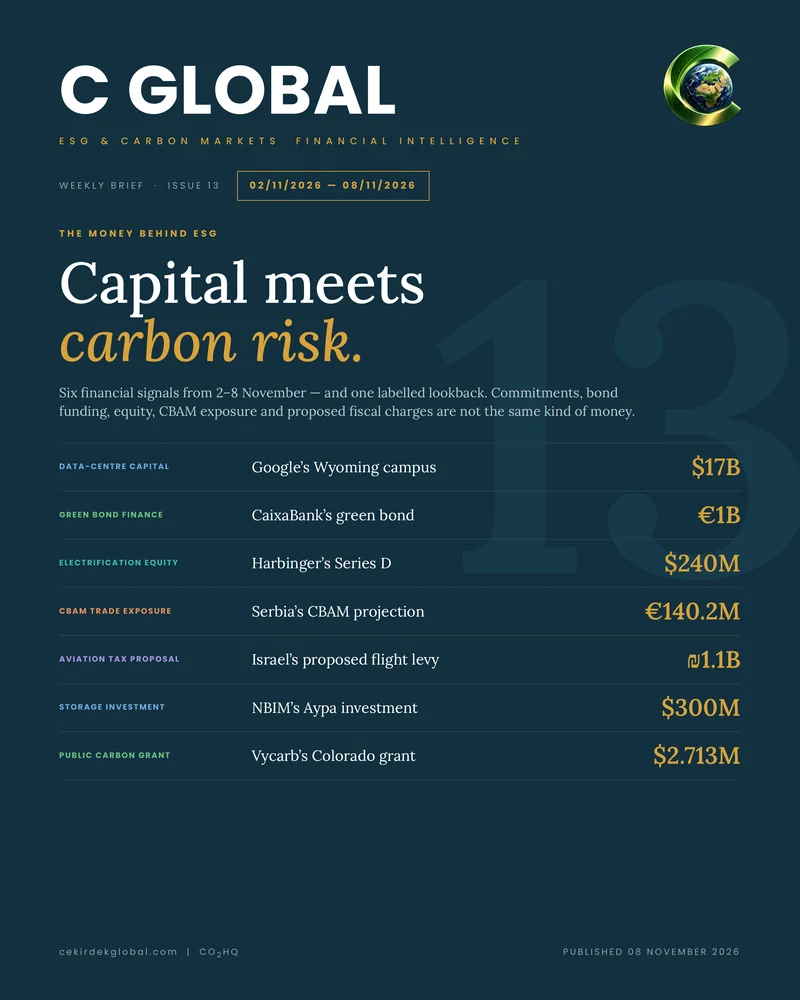
Latest · ESG Financial Intelligence Issue 13 · 8 Nov 2026
Six financial signals from 2–8 November and one labelled lookback — commitments, bond funding, equity, CBAM exposure and proposed fiscal charges are not the same kind of money.
Removal finance turns bankable, credit quality gets a price, governments become Article 6 buyers and CBAM gets real price tags: five trends from 50+ priced signals, June–November 2026.
Six financial signals from 2–8 November — from a US$240M Series D to a US$17B data-centre commitment — plus one labelled lookback.
Five signals from the last 72 hours — from a US$1.05M seed investment to US$10.4B of fund commitments, and two figures that are not transaction values.
Four signals from the last 72 hours — from a US$20M flood-recovery allocation to a US$8.03B tax benefit.
Five signals from the last 72 hours — from a ≈US$6M airline carbon-credit bill to ≈US$850M of battery-storage financing.
Eight signals from the last 72 hours — from a US$6M airline carbon bill to £4B in UK carbon-capture contracts.
Five signals from the last 72 hours — from a NOK 26.1B credit-purchase ceiling to a US$1–1.50 price premium per rating notch.
Five signals from the last 72 hours — each with a defensible monetary figure, from a US$6M carbon exit to a US$22.3B gas plant.
One signal in 72 hours: two digitally native tranches turn sovereign digital-bond infrastructure into a material green financing channel.
Four signals: Mombak's $150M Amazon fund, Vaulted Deep's $35M debt deal, California's $10B bill-credit plan and Big Tech's $1.4–3.6B removal pipeline.
Three signals: the Global Green Bond Initiative's private-capital target, the economic cost of Indonesia's 2026 fires, and a scenario value for Google's largest carbon-removal purchase.
One story in 72 hours: a blended fund built to unlock insurer capital for climate lending to emerging-market SMEs.
The first 72-hour brief: five signals, from a USD 24M+ carbon-infrastructure investment in Singapore to €18.3B a year of potential EU ETS revenue for industry.
Which countries make it into the global ESG news agenda, and which do not. A pilot study of 135 verified events coded against the 193 UN member states.
Nuclear plants shut by wildfire and low rivers, record heat deaths and an oil shock: what one July day says about compound physical risk, Scope 2 accounting and disclosure.
Ownership, scale, energy, geography and the trillion-dollar infrastructure race reshaping the physical backbone of the internet and AI.
Satellites can see methane leaks in real time, yet most go unfixed. Why the bottleneck in climate action is now accountability, not technology or capital.
€63 billion for offshore wind while Puerto Rico goes weeks without water: why water infrastructure and ISO 14046 belong in every climate strategy.
Heat deaths, a community solar farm forced offline by grid limits and a carbon-capture subsidy wave: adaptation metrics are the missing piece in ESG reporting.
Hydrogen engines, superhot geothermal and sodium-ion batteries on one side, a withdrawn net-zero pledge on the other: how to tell real transition plans from rhetoric.
2,700 heat deaths in France, record fusion and geothermal funding and an expanding CBAM: materiality redefined by mortality data.
A record US heatwave, El Niño pushing India back to coal and a bank financing regenerative farming: why fragmented sustainability responses no longer work.
Rock glaciers as water reserves, ocean carbon storage and residual-emission inequality: the case for moving past carbon tunnel vision.
Britain’s £90 billion grid overhaul, 24/7 clean power, the first North American DAC credits and ISSB’s nod to TNFD.
41.7°C in Germany and 1,300 heat deaths across Europe: climate adaptation has become the foundation of business continuity.
Videos

