
Why look back now
Since the summer, C GLOBAL has tracked the money moving around carbon in two formats: our daily ESG articles (June–July) and, from 12 September, the ESG Financial Intelligence brief, which admits a story only if it carries a defensible monetary figure. Twelve editions later, the archive holds more than 50 priced signals. Read one by one, they look like a stream of unrelated deals. Read together, they show a carbon market that is changing shape.
This article pulls the carbon-market signals out of that archive — from the late-June articles to Issue 13 (2–8 November 2026) — and asks two questions: what has actually changed, and where is the market heading? One caveat up front: this is a curated sample of disclosed deals, not a market dataset. It tells you about direction, not total volume.
Trend 1: carbon removal has become something you can borrow against
Six months ago, carbon removal was mostly a buyer's story: a tech company signs an offtake, a start-up announces a pilot. By the autumn, the story had moved to the lender's desk.
- September: Vaulted Deep raised US$35M of debt to scale US carbon removal, using contracted bio-waste and removal revenue as collateral (Issue 5).
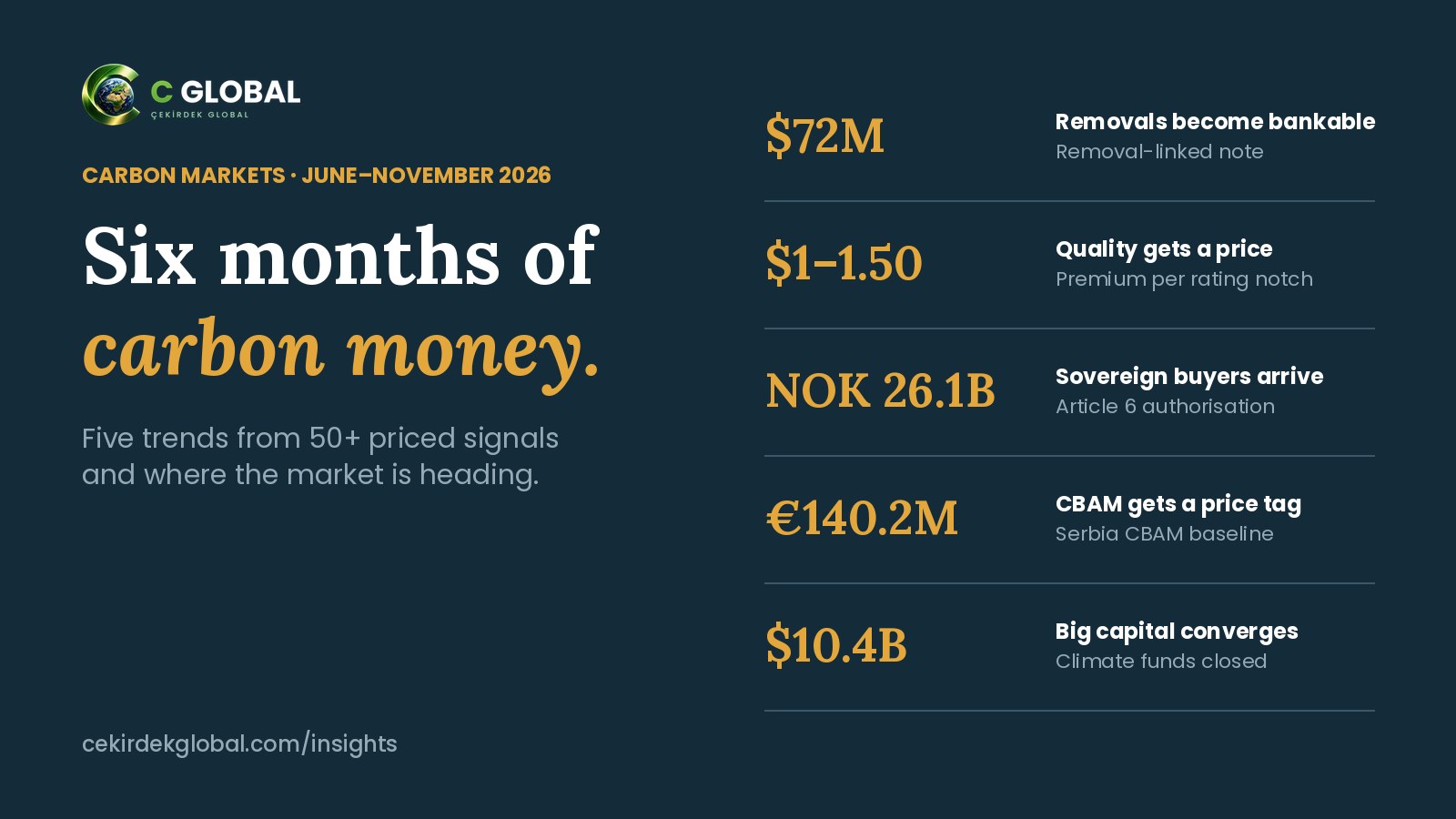
- October: Citi closed a US$72M removal-linked note for Applied Carbon's Texas biochar project — investors are repaid from verified credit delivery (Issue 11). A week later, Terradot closed a US$34M senior secured loan from HASI for enhanced rock weathering, backed by fixed-price Frontier offtakes and delivery insurance (Issue 12).
- Buyer side: Frontier buyers committed US$11.7M to 44.01's rock-mineralisation project in the UAE — about US$559 per tonne (Issue 10). Google signed its largest removal purchase to date with Terradot in Brazil, 1 million tonnes by 2040 (our scenario value: US$100–300M, brief of 19 Sep). A corporate coalition locked in 40M+ tonnes of nature-based removals (scenario: US$1.4–3.6B, Issue 5).
The pattern is clear: a signed offtake is now treated as a financial asset. Once an offtake has a fixed price, a creditworthy buyer and insurance against non-delivery, a bank can lend against it before a single tonne is removed. That is how project finance works in solar and wind, and it is the single most important structural change in the voluntary carbon market this year.
The price signal points the same way. In July we noted Deep Sky delivering North America's first direct air capture credits at a cost range of US$600–1,000 per tonne (30 June). Durable removals are settling into a high-price, long-contract segment that behaves more like infrastructure than like the old offset market.
Trend 2: quality now has a price — and so does delivery risk
The old voluntary market treated a tonne as a tonne. The autumn data says otherwise. BeZero found that higher-rated credits command a premium of US$1–1.50 per rating notch (Issue 8): independent ratings have moved from reputational comfort to price formation.
Delivery risk is being priced too. Circle Gas reported US$67M of contracted credits still awaiting delivery, dependent on authorisation (Issue 9). Carbon Streaming exited a community carbon stream for US$6M, but US$3.65M of that sat in escrow (Issue 7). Salesforce's five-year offtake for 500,000 rice-methane credits from Mitti Labs came without a disclosed price (Issue 12). Contracted is not delivered, and announced is not paid — which is exactly why every figure in our brief carries a label.
Where it goes: a two-tier market. Rated, insured, contract-backed credits will trade at a premium and attract debt. Unrated, unauthorised or undeliverable volume will be discounted — or will not trade at all.
Trend 3: compliance carbon is becoming a recurring line in the budget
Carbon is no longer only a voluntary sustainability spend. Over six months, our archive recorded it arriving in operating budgets and national treasuries:
- Airlines: Ethiopian Airlines spends about US$6M a year on carbon credits under CORSIA-linked obligations, and its CEO expects the bill to rise (Issues 9–10).
- Governments as buyers: Norway asked for authorisation of up to NOK 26.1B for Article 6 credits toward its 2035 target — up NOK 11.1B (Issue 8). Singapore's planned procurement of about 12 million tCO₂e implies S$300–660M (our scenario, brief of 12 Sep). Article 6 is turning into a sovereign-to-sovereign market.
- Revenue recycling: California's cap-and-trade programme is set to return US$10B in customer bill credits, with US$8B for the state climate fund through 2030 (Issue 5). EU ETS auction revenue of roughly €18.3B a year could become industrial capital (brief of 12 Sep).
- Fiscal carbon pricing: Israel's Tax Authority proposed a flight levy modelled at NIS 1.1B a year (Issue 13); a think tank framed Australia's fuel-tax-credit rollback as an A$198 per tonne carbon cost (Issue 12).
But the politics cut both ways. Ireland's Budget 2027 cut the home-heating carbon tax to €48.50 per tonne, reversing a scheduled increase (Issue 8). Carbon prices that reach households remain politically fragile; carbon prices on industry and trade are proving much more durable.
Trend 4: CBAM has moved from regulation to price tags
In July we wrote about the expansion of the EU's Carbon Border Adjustment Mechanism as a policy story. By November, it had become a set of numbers that finance ministries and steelmakers are putting on paper:
- Trasteel's CEO estimated the EU steel CBAM cost at about €5B a year — an industry view, not an official forecast (Issue 9).
- Serbia's Finance Ministry modelled €140.2M of 2026 CBAM exposure in its baseline scenario, at an illustrative €75.36 per tonne; €89.1M of it — about 63.6% — sits in iron and steel (Issue 13).
- The UK's CBAM design starts with a £50,000 registration threshold (brief of 12 Sep).
The Serbian document makes a point every exporter should notice: the bill depends on emissions data. Default emission values, unverified data and unrecognised domestic carbon prices push the number up. Verified, product-level emissions data pulls it down. CBAM is turning measurement into money.
The calendar matters here. CBAM's definitive period began on 1 January 2026; certificate sales start on 1 February 2027, and the first annual CBAM declaration is due on 30 September 2027. The EU's second emissions trading system (ETS2) follows in 2028.
Trend 5: capture infrastructure and big capital are converging
The largest numbers in our archive are not carbon-credit deals at all, but they shape the carbon market around them. UK CCUS projects awarded more than £4B in supply-chain contracts, while the CCSA warned that policy delays could put £26B of further private investment at risk (Issue 9). The EU allocated €119.8M to industrial carbon-management research (Issue 9). In November, Google set out a US$17B Wyoming data-centre commitment tied to gas fuel cells with planned carbon capture and storage (Issue 13). Colorado offered Vycarb up to US$2.7M to demonstrate carbon management in wastewater treatment (Issue 13).
Meanwhile, the capital pools are getting bigger. TPG closed US$10.4B across climate funds, US$2.5B of it for the Global South (Issue 12). Norway's sovereign fund paid US$300M for 10% of battery developer Aypa Power (Issue 13) — the same company Brookfield bought for about US$7B, which we covered in July. Grid flexibility and storage are now core institutional assets, and they set the backdrop for how much carbon-intensive power the next wave of AI data centres will need.
Where the market is going: five things to watch into 2027
- 2027 is the year compliance cash starts to flow. CBAM certificate sales open in February 2027, Türkiye's ETS moves from a reporting-only pilot in 2026 to pricing in 2027, and ETS2 arrives in 2028. Expect more "exposure" estimates like Serbia's to turn into actual invoices.
- Removal finance will look more like project finance. After Citi, HASI and Vaulted Deep, the next step is repeatable structures: portfolio loans, insured offtakes, perhaps securitisation. The buyers who sign long-dated, fixed-price offtakes are effectively underwriting the industry.
- Price dispersion will widen. Durable removals at several hundred dollars per tonne, rated nature-based credits at a premium, and a long tail of low-quality legacy credits at a discount. A single "carbon price" for voluntary credits will mean less and less.
- Governments will be the anchor buyers of Article 6. Norway, Singapore and others are creating predictable sovereign demand. Host-country authorisation will become the gate that decides which credits are worth anything.
- Data is the cheapest abatement. In CBAM, ETS and voluntary markets alike, verified emissions data (ISO 14064-1 inventories, product carbon footprints, third-party verification) is what turns a default, penalising number into a defensible one.
What this means for companies in Türkiye and emerging markets
For exporters of steel, aluminium, cement, fertilisers and electricity, the Serbian estimate is a useful mirror: two thirds of the modelled exposure sits in a single sector, and the size of the bill depends on the quality of emissions data. Companies that build a verified, product-level emissions dataset before certificate sales open in February 2027 will negotiate from a stronger position with EU buyers than companies that rely on default values.
For project developers, the lesson of the past six months is that the market is rewarding bankability: authorisation, ratings, insurance and long-term offtakes. And for every company reading these headlines, the discipline that runs through our brief applies: always ask whether a number is committed, issued, raised, paid, projected or proposed. They are not the same money.
Method and sources
This review draws only on content already published on cekirdekglobal.com: the ten ESG articles of 29 June–30 July 2026, the three 72-hour briefs of 12, 15 and 19 September, and ESG Financial Intelligence Issues 5–13 (24 September–8 November 2026). Each figure keeps the label it carried in the original issue; scenario ranges are our estimates where contract prices were undisclosed. Original sources are listed in each issue's PDF. Regulatory dates were checked on 5 November 2026.